

When you open a food package, you’ll often see calorie values listed in the nutrition facts—sometimes in kilojoules (kJ), sometimes in kilocalories (kcal). Many people feel confused when seeing these units, wondering, “How many kilocalories is 1000 kilojoules? How do you convert 1000 kilojoules into kilocalories?” To answer these questions, let’s first dive into the basics of heat units.

In the field of heat measurement, common units include joules (J), kilojoules (kJ), calories (cal), and kilocalories (kcal). The joule is the international standard unit of energy, and the kilojoule is a derivative unit (1 kJ = 1000 J).
Calories and kilocalories are more commonly used in daily life, especially in diet and health (1 kcal = 1000 cal). The key conversion factor between kilojoules and kilocalories is: 1 kilocalorie is approximately equal to 4.184 kilojoules. This ratio is essential for all unit conversions.
So, how do we convert 1000 kilojoules to kilocalories? Using the formula:
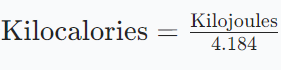
Plugging in 1000 kJ, we get:
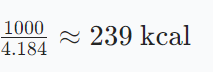
To visualize this, let’s compare it to common foods:
100 grams of whole-grain bread contains about 250 kcal, making 1000 kJ roughly equivalent to 95 grams of whole-grain bread.
100 grams of boiled chicken breast has about 118 kcal, so 1000 kJ is roughly equivalent to 202 grams of boiled chicken breast.
These comparisons help us grasp the actual “size” of 1000 kJ in daily eating.
Mastering the conversion between kilojoules and kilocalories is crucial for daily diet control and exercise planning.
Whether you’re trying to lose weight, build muscle, or maintain a healthy weight, accurate calorie tracking is key. Beyond conversions, here are answers to some frequently asked questions about heat units:
Q: Does cooking method affect a food’s kilojoule or kilocalorie content?
A: Yes, it does. Cooking methods like frying or deep-frying add large amounts of oil, significantly increasing calorie content.
For example, 100 grams of raw potato contains about 320 kJ (76 kcal), but when made into French fries, the calorie content can soar to over 800 kJ (191 kcal).
In contrast, steaming or boiling rarely add extra oil, preserving the food’s original calorie content.
Q: How many kilojoules or kilocalories do adults need to burn daily?
A: This varies by age, gender, physical condition, and activity level. On average:
Adult women typically need to burn 8,400–10,000 kJ (2,000–2,400 kcal) daily (including basal metabolism and daily activities).
Adult men typically need 9,600–12,500 kJ (2,300–3,000 kcal).
Higher activity levels will naturally increase calorie burn.
Q: Are the kilojoule or kilocalorie readings on fitness trackers accurate?
A: Fitness trackers estimate calorie burn through algorithms, so there is some margin of error.
They calculate based on data like heart rate, exercise duration, and stride frequency, combined with preset activity models and baseline data.
While not 100% precise, they provide a useful estimate to help you understand exercise intensity and overall calorie expenditure.
Understanding the conversion between kilojoules and kilocalories is like holding a key to a healthier lifestyle. Whether you’re counting food calories or planning workout goals, this knowledge empowers better decisions.
Have you ever had an interesting discovery or confusion while tracking calories in food or exercise? Share your thoughts in the comments below!

